Tones · about 3 minutes
Tone Ear Trainer
Before you can tell two tones apart you have to know what one sounds like on its own. This plays a single tone, eight clear times, with nothing to answer.
No signup. No quiz, no score.
Today’s Plan reaches for this when tone answers start slipping — recalibration before more testing.
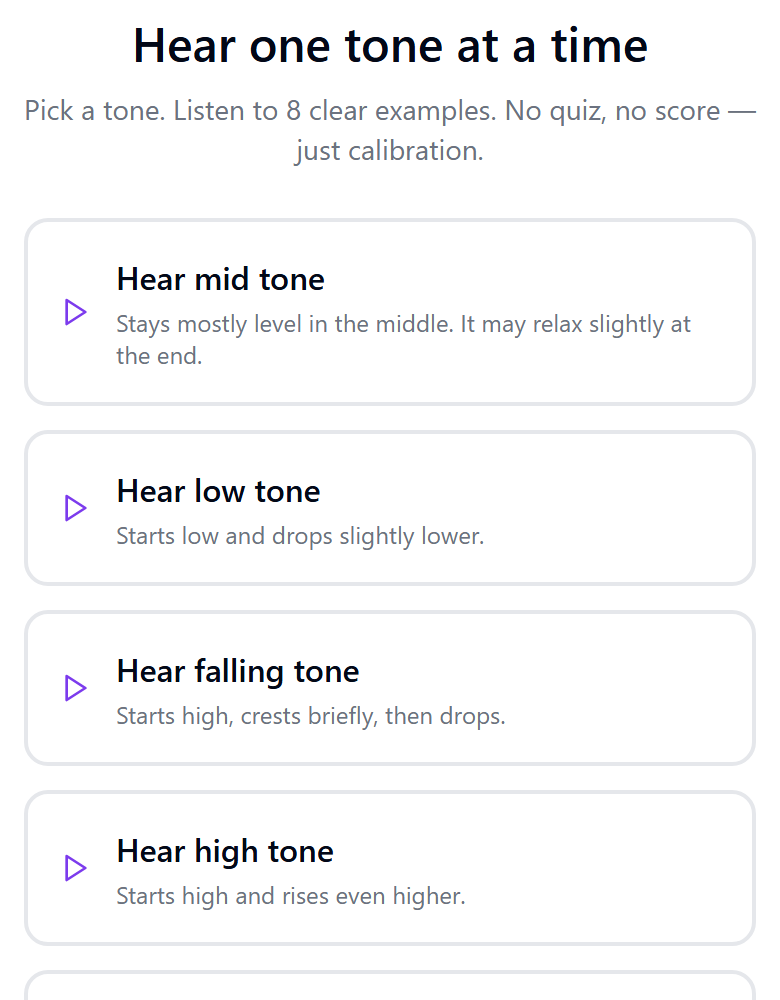
What a round looks like
Calibration, not assessment
Eight examples of one tone, and nothing to get wrong
Every other tone surface asks you something. This one does not. You pick a tone, you hear it eight times in different words, and your ear settles. Being tested while you are still forming the category is what makes tones feel impossible.
And the two pairs that actually confuse people
High against rising, and mid against low. Those are the confusions that survive months of practice, so they get their own side-by-side listening rather than waiting to show up as errors.
No score is kept here on purpose. A calibration exercise with a percentage attached becomes a test, and a test is the thing you were avoiding.
- 5
- tones, eight examples each
- 2
- contrast pairs: high/rising, mid/low
- No score
- nothing is graded here
- ~3 min
- a full pass
When your ear is settled
Tone Pairs asks whether two words share a tone — the judgement conversation needs.
Tone PairsWhy the tone is what it is
Tone Ladder teaches the rules that predict a tone from its spelling.
Tone Ladder