Thai Sentence Segmentation: Learn to See Word Boundaries
Thai is written without spaces between words. For learners, this means reading Thai requires an extra skill that English readers never need: word segmentation — the ability to see where one word ends and the next begins in a continuous stream of characters.
A short introduction to finding word breaks in a sentence with no spaces.
No account required. Your progress is saved on this device.
นกบินอยู่บนฟ้า
The bird is flying in the sky.
14 characters, no gaps. How many words is that, and where does each one end?
ตอนที่ฝนตกผมอยู่บ้าน
When it rained I was at home.
20 characters, no gaps. How many words is that, and where does each one end?
This is why vocabulary and segmentation are the same problem in Thai. You do not learn to see the gaps in the abstract — you learn enough words that the gaps appear on their own.
- Spaces between words
- none
- Anchor words used
- top 200
- Stages
- 3
Word segmentation is not guesswork. Thai readers use several reliable cues: common word patterns, grammar particle positions, vowel and tone mark placement, and high-frequency word recognition. These cues become automatic with practice.
Fluent Thai offers dedicated segmentation drills that progress from finding known words in short phrases to inserting word boundaries in full sentences. Combined with guided reading practice, these drills build the segmentation instinct that Thai readers use naturally.
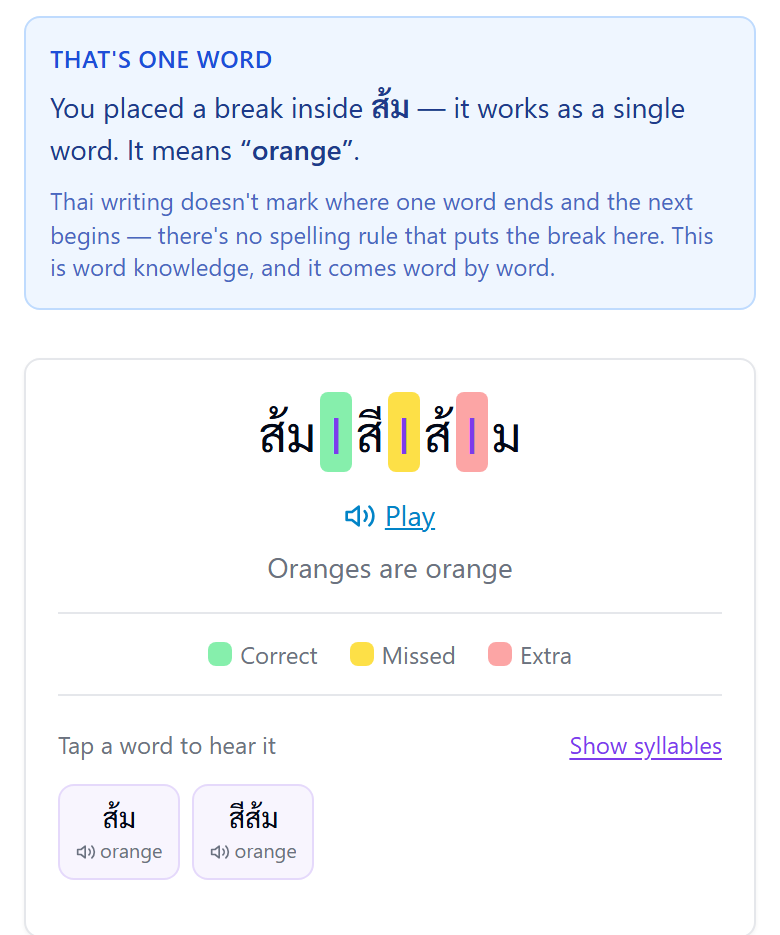
Practise this
Blur Breaker
Tap the word boundaries yourself; the feedback names the word you split.
Reading Practice
Adjustable word spacing lets you gradually remove spaces as segmentation improves.
Listen & Read
Listen-read-segment workflow builds segmentation in context with comprehension.
How to practise in ten minutes
- Open Blur Breaker in "Find the Words" mode — do 3 sentences (3 min).
- Switch to "Insert Boundaries" mode for 2 sentences (3 min).
- Open Reading Practice — select a Tier 2 sentence with reduced spacing (2 min).
- Try to read without tapping any words, then tap to check your guesses.
- Return to Blur Breaker — try "Spot Particles" mode for 2 rounds (2 min).
Common questions
Why does Thai not use spaces between words?
How do Thai people read without spaces?
What are Thai particles and why do they matter for segmentation?
How long until I can read Thai without spaces?
Now try it
You have read how it works. This is the drill that makes it stick — a few minutes, and it brings you back here when you are done.
Practise this: Blur Breaker