Learn the Thai Alphabet: Consonants, Vowels, and Tone Marks
The Thai alphabet consists of 44 consonants, 33 vowel spelling patterns (traditionally counted as 21 forms making 32 sounds), and 4 tone marks. Unlike Latin-based writing systems, Thai is an abugida — consonants carry an inherent vowel sound, and vowels are written around the consonant in various positions (above, below, before, or after).
See and hear a handful of Thai letters, one at a time. Nothing to score.
No account required. Your progress is saved on this device.
Mid class9 letters
High class11 letters
Low class24 letters
Two letters are no longer used in modern Thai and are shown faded. Tap any letter to hear it.
- Consonants
- 44
- Still in use
- 42
- Consonant classes
- 3
- Vowel forms
- 33
- Tone marks
- 4
- Alphabetical order
- yes
Learning the Thai alphabet is the single most impactful investment you can make as a Thai learner. Once you can read, you unlock correct pronunciation through tone rules, you stop relying on romanization (which is inconsistent), and you can learn new words from signs, menus, and subtitles.
Start with the consonants — specifically the 9 mid-class consonants — then learn high-class and low-class. After consonants, move to vowels (short vs long pairs). Fluent Thai offers drills for every stage of this process.
Go further with the full lessons
This guide is the overview. These lessons are the material itself.
See all 44 Thai consonants, grouped by class
The full alphabet on one page — every consonant with its name, its class, and the example word Thai learners are taught it by. This guide describes the set; the lesson is the set.
Learn the three consonant classes and the tone rules they set
Mid, high and low, and why the class of the first consonant decides the tone of the syllable. This is the rule the reading order above is built around.
Practise this
Consonant Trainer
Class identification and sound matching drills for all 44 Thai consonants.
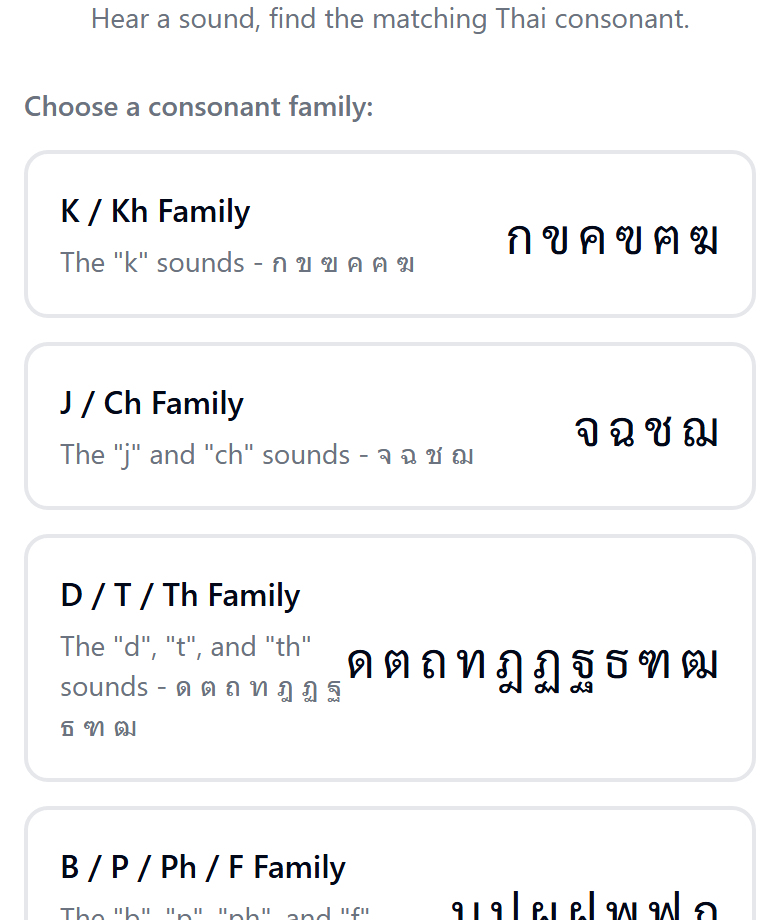
Sound-to-Letter Match
Audio-first drill: hear a consonant sound and pick the matching Thai letter.
Sound + Picture Sandbox
Tap-to-hear exploration of Thai words to connect letters with real pronunciation.
How to practise in ten minutes
- Open Consonant Trainer in "Pick the Class" mode — do 10 rounds (3 min).
- Focus on mid-class consonants first: ก จ ด ต บ ป อ ฎ ฏ.
- Switch to Sound-to-Letter Match and do one consonant family (3 min).
- Open Sound + Picture Sandbox and tap 5 words, noting their first consonant (2 min).
- Return to Consonant Trainer for 5 more rounds on your weakest class (2 min).
Common questions
How many letters are in the Thai alphabet?
Is the Thai alphabet hard to learn?
Should I learn the Thai alphabet or just use romanization?
What order should I learn the Thai alphabet?
How long does it take to read Thai?
Now try it
You have read how it works. This is the drill that makes it stick — a few minutes, and it brings you back here when you are done.
Practise this: Consonant Trainer