Thai tones explained (and how to practice them)
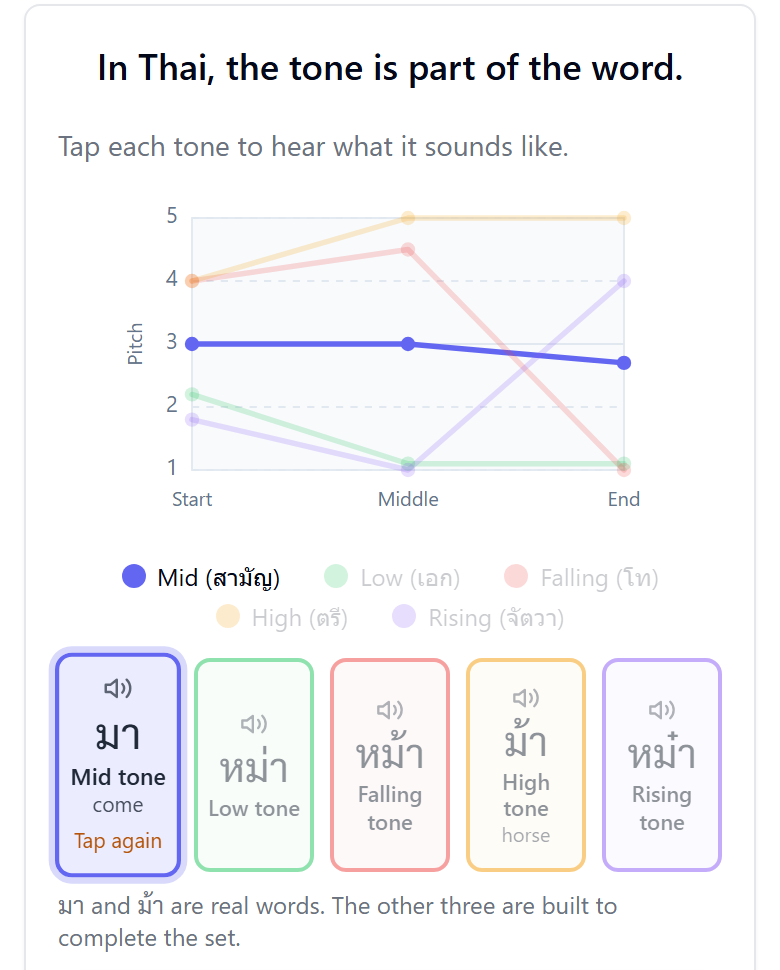
Thai has five tones, and they matter: the same consonants and vowels can mean different things depending on pitch contour. Here they are on one syllable — press each one to hear it.
The same syllable said five ways, back to back. Nothing to answer yet.
No account required. Your progress is saved on this device.
Tap each tone to hear what it sounds like.
มา and ม้า are real words. The other three are built to complete the set.
- Tones
- 5
- Tone marks
- 4
- Carried by
- every syllable
The fastest path isn't memorizing a wall of rules. It's (1) training your ear, (2) connecting tones to real speech, and (3) using rules later to support reading.
Practise this
Tone Pairs
Train tone discrimination with fast feedback in short rounds—ear first, rules later.
Pronunciation Loops
Bridge listening → speaking by matching rhythm and tone contour in real phrases.
Consonant Trainer
Tone rules depend on consonant class; drill recall so reading doesn't feel random.
How to practise in ten minutes
- 4 min — Tone Pairs (focus on your weakest contrast)
- 4 min — Pronunciation Loops (repeat a short line until contour feels natural)
- 2 min — Re-do the tone pair(s) you missed most
Common questions
Do I need to learn tone rules first?
How long does it take to get tones?
Will tone drills help my speaking?
Now try it
You have read how it works. This is the drill that makes it stick — a few minutes, and it brings you back here when you are done.
Practise this: Tone Pairs