Thai Speaking Practice: From Drills to Real Conversations
Speaking Thai requires coordinating tones, vocabulary, grammar, and politeness conventions simultaneously. Many learners understand Thai when they hear it but freeze when they need to produce it. The solution is structured speaking practice that builds production skills incrementally.
Practice six useful Thai words you can say — by ear, no signup required.
No account required. Your progress is saved on this device.
1Listen once
Don’t speak yet. Just hear the model.
2Say it back once
Out loud, at full volume. Don’t wait until it feels perfect.
3Listen again
Find one thing that did not match, fix that, and say it once more.
If a phrase is too long to hold in your head, shorten it. Half a phrase said accurately beats a whole one guessed at.
Three words you will use every day
On their own these are for everyone. Nothing here is male or female yet.
- สวัสดีhello, and goodbye
- ขอบคุณthank you
- ขอโทษsorry, and excuse me
Then the ending that says who is speaking
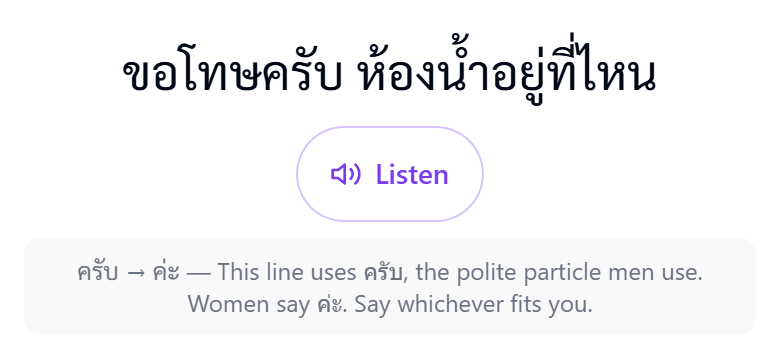
Thai politeness is one syllable on the end, and which one you use depends on you — not on the person you are talking to. Add it to any of the words above.
- ครับkhraptypically used by male speakers · statements and questions alike
- ค่ะkha (falling)typically used by female speakers · statements and answers
- คะkha (high)typically used by female speakers · questions and requests
Each is spoken by the voice that would use it. Say สวัสดี and then your ending, and you have a complete, polite greeting.
Phrases that are the same either way
The words are the same whoever is speaking. In a polite exchange you would still add your ending on the end of most of them.
- ไม่เข้าใจI don't understand.
- อีกทีได้ไหมOne more time?
- ช้าๆ หน่อยA bit slower, please.
- ไม่เป็นไรit's OK; no problem
- เท่าไหร่How much?
Nobody is listening, which is the advantage. Saying a phrase badly out loud teaches you more than reading it correctly in your head.
- Words to start
- 3
- Endings
- 3
- Partner needed
- no
Effective speaking practice progresses through three stages: repetition (shadowing and pattern drills), guided production (roleplay with prompts), and free production (open conversation). Each stage builds confidence for the next.
Fluent Thai offers drills for every stage — from shadowing individual sentences to navigating full roleplay scenarios at a café, market, or taxi. Start with repetition and progress to guided conversations as you build confidence.
Practise this
Can-Do Roleplay
Weekly mini-outcomes test your ability to handle specific real-world conversations.
Memory Builder
SRS vocab review builds the vocabulary foundation for speaking.
How to practise in ten minutes
- Open Memory Builder and do 10 vocab reviews to activate vocabulary (2 min).
- Open Pronunciation Loops and shadow two of the phrases above until you keep pace (4 min).
- Open Can-Do Roleplay — pick a scenario (café, taxi, market) and play through it (3 min).
- Review your score — note which turns you struggled with (1 min).
Common questions
How can I practice speaking Thai without a partner?
Why do I understand Thai but cannot speak it?
How important are polite particles (ครับ/ค่ะ) in Thai?
What are the most useful Thai phrases to learn first?
Now try it
You have read how it works. This is the drill that makes it stick — a few minutes, and it brings you back here when you are done.
Practise this: Can-Do Roleplay